
Wednesday, May 13, 2015
Julia Child The French Chef- Vegetables The French Way
Oh yeah Julia makes vegetables look sexy. Hey Butter butter butter!

Friday, October 3, 2014
Monday, September 22, 2014
Know thy fat
We all know fat gets a bad rap. But high quality are actually good for us. Benefits include hormone production, the building healthy cells, improved skin quality, energy, and help us to absorb the fat soluble vitamins A, D, E, and K. My favorite being they provide satiety. Satiety means how full and satisfied you feel after eating. The key is getting the right ones and using them properly. I've created this chart to help you with your fat needs.

Avoid vegetable oils like the plague:
If there is anything you take away from this post, I hope it's avoiding vegetable seed oils like canola oil and soybean oil. Traditional animals fat were used until cheap oil we're introduced to the US in the 1960s. However, we are now seeing the health repercussions. One of the main problems with vegetable oils such as soybean, cottonseed, and canola oil is their high amount of Polyunsaturated Fatty Acids or PUFAs. Not only that, PUFA’s are also highly unstable thus creating trans-fat.
A note about restaurants:
Most cook with the cheapest oils which are vegetable oil aka trans fat. It's hard to avoid but you can always order a salad and make sure the dressing has olive oil. Also opt for steamed and baked foods.
P.S. Roasted potatoes in lard - oh so lovely!
Avoid vegetable oils like the plague:
If there is anything you take away from this post, I hope it's avoiding vegetable seed oils like canola oil and soybean oil. Traditional animals fat were used until cheap oil we're introduced to the US in the 1960s. However, we are now seeing the health repercussions. One of the main problems with vegetable oils such as soybean, cottonseed, and canola oil is their high amount of Polyunsaturated Fatty Acids or PUFAs. Not only that, PUFA’s are also highly unstable thus creating trans-fat.
A note about restaurants:
Most cook with the cheapest oils which are vegetable oil aka trans fat. It's hard to avoid but you can always order a salad and make sure the dressing has olive oil. Also opt for steamed and baked foods.
P.S. Roasted potatoes in lard - oh so lovely!
Wednesday, August 27, 2014
The Great Extra-Virgin Olive Oil Scam in America
Yikes! I guess my Spanish olive oil from Trader Joe's is out. None the less, the more you know the more you grow. Here's some good insight regarding the olive oil scam.
Olive experts estimate that between 50% and 80% of extra virgin olive oil in U.S. grocery markets is not really extra virgin. In fact, much of the olive oil sold to Americans isn't even produced from olives... and is purposely mislabelled.
Further, the USDA is fully aware of this ongoing fraud, yet has failed for years to notify the public and has done precious little to deter the great olive oil hoax.
Chris Kimball, founder of America's Test Kitchens, recently commented on his weekly radio show, "EVOO clearly doesn't mean anything since most EVOO in American markets are not extra virgin...." He added that buying olive oil in grocery stores is "a complete crapshoot."
Here's the deal in a nutshell: the U.S. retail market for olive oil is largely unregulated, thereby allowing European olive growers to freely dump their crummiest-quality crops in the U.S., usually in fancy, high-priced bottles with impressive labels to attract naive buyers.
In contrast, olive oil sold in most European countries must meet standards set by the International Olive Council, or risk heavy fines and removal from shelves. And worse, shamed olive oils risk being ostracized by informed, offended European consumers.
Not so in the U.S., where standards are minimal, enforcement is non-existent, and consumers are willing to pay huge prices for what they mistakenly assume is a high-quality product.
Per Dan Flynn, Director of the UC Davis Olive Center, imported olive oils are often diluted "with other, cheaper-to-produce oils... No one is even checking to see if its made from olives."
Tom Mueller, author of the 2007 New Yorker article Slippery Business - The Trade in Adulterated Olive Oil, reports that under the guise of olive oil, Italian purveyors were caught "selling Turkish hazelnut oil and Argentinian sunflower oil."
Wrote the New York Times about Muellers' 2011 book Extra Virginity: The Sublime and Scandalous World of Olive Oil, "The news Mr. Mueller brings about extra virgin olive oil is alarming. The liquid that gets passed off as such in supermarkets and restaurants is often anything but. Shady dealers along the supply chain frequently adulterate olive oil with low-grade vegetable oils and add artificial coloring."

So what's a smart U.S. olive oil buyer to do? Experts offer the following suggestions:
First, don't buy imported olive oils, as the U.S. government is simply not testing for what it regards as a low-priority problem.
Second, become familiar with the USDA's first stab at voluntary olive oil requirements. Entitled United States Standards for Grades of Olive Oils, the newly-issued guide is voluntary and covers only oils produced and sold in the U.S.
Although, according to Mr. Flynn, two panels in the U.S. periodically test a sampling of American olive oils, neither group has proven oversight or has been certified by the International Olive Council.
Third, buy California olive oils when feasible, as the state is attempting to understand and control its burgeoning, artisan industry via the California State Senate Agriculture Committee's Subcommittee on Olive Oil Production.
"California produces, by and large, true extra-virgin olive oil," commented olive oil consultant Alexandra Kicenik Devarenne on a recent America Test Kitchen broadcast. Ms. Devarenne added that the current California industry is not engaged in "the same race to the bottom to produce the cheapest EVOO."
U.S. olive oil is produced mainly in California, with smaller volumes coming from Arizona and Texas.
One more suggestion: complain to the USDA. Complain loudly and complain often.
After all, America's great extra-virgin olive oil scam is fraud, plain and simple. And no one is protecting the American consumer, who is being duped and swindled while enrichening the gilded coffers of olive oil crooks.
Tuesday, February 25, 2014
Scant Evidence To Support Vitamins Against Cancer, Heart Disease
by Scott Hensley | NPR

If you're taking vitamins to guard against cancer or a heart attack, you've got plenty of company.
Nearly take a vitamin of some kind each a day. About a third take a multivitamin.
But are they worth it?
For people in good health and without any special nutritional deficiencies, there isn't enough evidence to say it's a good idea — at least when it comes to preventing cardiovascular disease and cancer.
That's the verdict from the , an influential panel of doctors, nurses and scientists who weigh the evidence and make recommendations on medical care. The group on vitamins Monday in Annals of Internal Medicine.
"If you're taking those supplements now, you're doing so on the basis of hope — not science," says , co-vice chairman of the task force. "Unfortunately at this point in time, the science is not sufficient for us to estimate either the harm or the benefit from taking supplements specifically to prevent cancer or heart disease."
There are two exceptions. LeFevre tells Shots there's enough scientific information available to say that there's no reason to take the antioxidants beta carotene or vitamin E to ward off cardiovascular disease or cancer. And there's evidence that beta carotene can raise the risk of lung cancer among people at high risk for the disease, such as current smokers.
In December, three studies (also published in the Annals of Internal Medicine) that looked at the value of multivitamins and supplements in the prevention of disease, that minced no words:
How did the notion that taking vitamins above and beyond the nutrients in our food would improve our health take hold? "I think this is a great example of how our intuition leads us astray," , a professor of medicine at Johns Hopkins told Shots then. "It seems reasonable that if a little bit of something is good for you, then more should be better for you. It's not true. Supplementation with extra vitamins or micronutrients doesn't really benefit you if you don't have a deficiency."
If you're taking vitamins to guard against cancer or a heart attack, you've got plenty of company.
Nearly take a vitamin of some kind each a day. About a third take a multivitamin.
But are they worth it?
For people in good health and without any special nutritional deficiencies, there isn't enough evidence to say it's a good idea — at least when it comes to preventing cardiovascular disease and cancer.
That's the verdict from the , an influential panel of doctors, nurses and scientists who weigh the evidence and make recommendations on medical care. The group on vitamins Monday in Annals of Internal Medicine.
"If you're taking those supplements now, you're doing so on the basis of hope — not science," says , co-vice chairman of the task force. "Unfortunately at this point in time, the science is not sufficient for us to estimate either the harm or the benefit from taking supplements specifically to prevent cancer or heart disease."
There are two exceptions. LeFevre tells Shots there's enough scientific information available to say that there's no reason to take the antioxidants beta carotene or vitamin E to ward off cardiovascular disease or cancer. And there's evidence that beta carotene can raise the risk of lung cancer among people at high risk for the disease, such as current smokers.
In December, three studies (also published in the Annals of Internal Medicine) that looked at the value of multivitamins and supplements in the prevention of disease, that minced no words:
"The message is simple: Most supplements do not prevent chronic disease or death, their use is not justified, and they should be avoided."
How did the notion that taking vitamins above and beyond the nutrients in our food would improve our health take hold? "I think this is a great example of how our intuition leads us astray," , a professor of medicine at Johns Hopkins told Shots then. "It seems reasonable that if a little bit of something is good for you, then more should be better for you. It's not true. Supplementation with extra vitamins or micronutrients doesn't really benefit you if you don't have a deficiency."
Wednesday, December 11, 2013
Gordon Ramsay's Broccoli Soup Recipe
I really enjoy this recipe. It's super easy, nutritious, and tasty. Gets you ready for the cold weather! Enjoy!
Tuesday, December 3, 2013
Cookie-Baking Chemistry: How To Engineer Your Perfect Sweet Treat

In a time-lapse video, a baking cookie almost looks like a creature coming alive as it spreads out and then rises up.:
"In a time-lapse video, it looks like a monster coming alive," says the team from in a new animation that — just in time for the holidays — explains the science behind great cookie baking. "For a moment, it [the raw dough] sits there innocuous ... then it bulges outward ... it triples in volume. Its color darkens ominously. And its surface hardens into an alien topography of peaks and craters. ... The kitchen timer dings: Your cookies are ready."
So what's going on in that oven? How does the heat make our snickerdoodles and chocolate chippers so delicious?
It's all about the chemistry.
"Don't let that apron deceive you. Bakers are mad scientists," the narrator of the animation says. "When you put the raw cookie dough into the oven, you're setting off a series of chemical reactions."
By playing around with the ingredients in your favorite recipe, you can tweak these reactions and engineer your ideal cookie. For instance, you can make it chewier, fluffy or thinner.
We'll get to that part in a moment, but first, let's take a look at the three major steps of the cookie-baking process:
- The spread: As the cookie dough starts to heat up, the butter inside it melts. The ball of dough loses its structural integrity and spreads out. The diameter of the cookie is set by how long the cookie expands.
- The rise: At about 212 degrees Fahrenheit, the water in the dough turns into steam. The cookie starts to rise as the vapors push through the dough. Eventually, the baking soda or powder starts to break down into carbon dioxide gas, which raise up the cookie farther. All these gases leave little holes in the maturing cookie, which makes it light and flaky.
- Color and flavor injection: Now the magic really starts to happen. Just as the cookie is almost finished baking, two chemical reactions fill it with hundreds of flavors and infuse it with its characteristic brown hue. First off, there's : As sugars in the dough break down, they transform from clear, odorless crystals into a brown, fragrant liquid that's overflowing with aromas and tastes — think butterscotch, sweet rum and popcorn. The second yummy process, called the , packs the cookie with even richer tastes. The reaction involves not only the sugars in the dough but the proteins from the egg and flour as well. So it churns out toasty, nutty and even savory flavors. The Maillard reaction also helps to darken the cookie's surface.
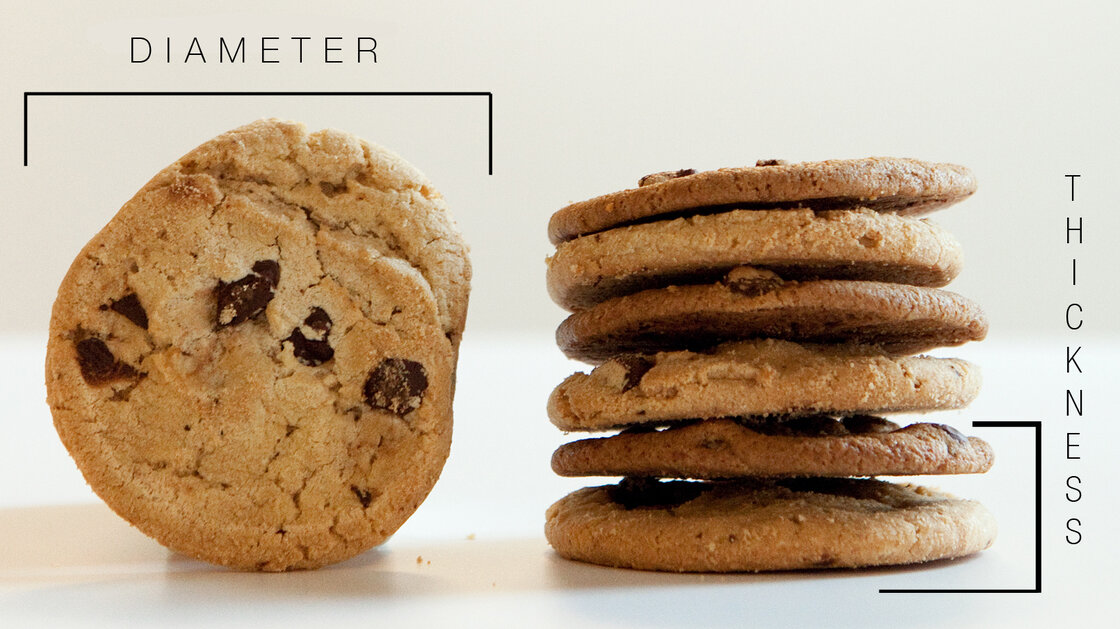
"Say I have a cookie recipe, and it's not quite what I want," she says. "You can take these basic concepts and use them to engineer the perfect cookie."
Take, for instance, the cookie's diameter. Its size depends on how quickly the dough spreads out as the butter melts in the oven.
"If you start off with melted butter in the raw dough — instead of cold butter chunks — the dough is immediately wetter and will spread out faster," Roth-Johnson tells The Salt. The result is a flatter, wider cookie.
But the butter's temperature will also affect the cookie's texture. It changes the air pockets left behind as the water in the butter converts into gas, Roth-Johnson explains.
Melted butter creates smaller and more holes. That makes for a chewier cookie.
"On the other hand, if you incorporate chunks of cold butter into the dough, you get larger pockets of air and a fluffier, cakier cookie," she explains.
You can also switch out the baking soda for baking powder for a fluffier treat. "The powder gives the cookie an extra kick of leavening," she says, "because it produces carbon dioxide gas both when it's mixed in the dough and when it heats up."
To make a thicker cookie, Roth-Johnson says, try using more flour.
Finally, you can pump up the cookie's flavor and aromas by spiking the dough with dark sugars. White granulated sugar doesn't participate very well in the Maillard reaction because it contains mostly sucrose. Darker sugars — like molasses, honey and brown sugar — are packed with glucose and fructose, which are happy to churn out rich, complex tastes from the Maillard reaction.
Subscribe to:
Comments (Atom)